
Description
PrymaLab · Research Use Only
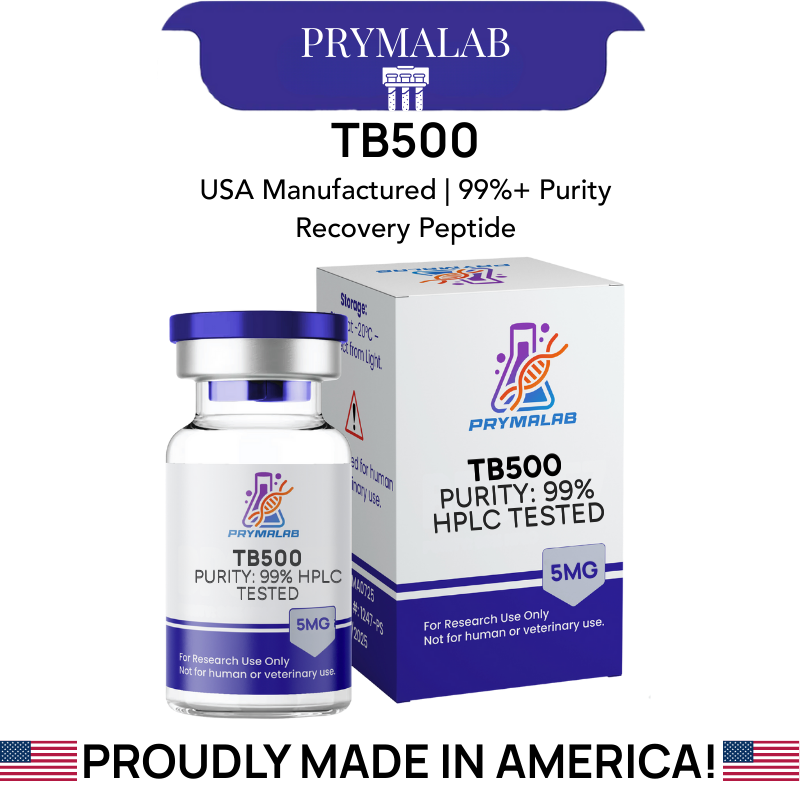
TB-500 5mg
Five milligrams of what, exactly, in moles
Every other fill page in this catalogue works out how many moles are in the vial. On tb 500 5mg that calculation cannot be completed, because the designation covers more than one article and their masses are not close.
Specification Table
| Property | Value |
|---|---|
| Name as sold | TB-500 |
| What the name describes | A trade designation rather than a defined chemical entity |
| Declared content | 5 milligrams |
| Candidate article one | Thymosin beta-4, the full 43-residue protein |
| Mass of candidate one, acetylated | Approximately 4,963 |
| Molar content if candidate one | Around 1.0 micromole |
| Candidate article two | A shortened construct built around the actin-binding region |
| Mass of candidate two | Depends on the construct, usually under 1,000 |
| Molar content if candidate two | Around 5.6 micromoles at a mass of 890 |
| Ratio between the two | More than five to one |
| CAS for thymosin beta-4 | 77591-33-4 |
| Which this vial contains | Per the lot-specific certificate. Ask for the sequence |
| Acetylation mass difference | Forty-two daltons |
| Sibling fill in this catalogue | 10 milligrams |
| Storage | Sealed at minus 20°C, dark and dry |
Why Can a TB 500 5mg Molarity Not Be Calculated?
Because molarity needs a molecular weight. A tb 500 5mg vial does not have one until somebody names the sequence.
The 10mg page in this catalogue covers the identity question in full and it is the place to read the background.
The consequence for a fill page is arithmetic rather than nomenclature.
If the vial contains the full 43-residue protein at roughly 4,963 daltons, 5 milligrams is about 1.0 micromole.
If it contains a shortened construct near 890 daltons, that same 5 milligrams is about 5.6 micromoles instead.
That is a factor of five and a half in the number of molecules, from the same mass, on the same label.
Reconstituted into 1 millilitre, one of those is a 1 millimolar stock and the other is 5.6 millimolar.
Any experiment run at a nominal molar concentration derived from the label is therefore wrong by an unknown factor between one and five and a half, and the direction depends on which assumption the person made.
This is the only article in the catalogue where I would say the concentration is not merely uncertain but uncalculable, and it takes one line on a certificate to fix.
What Does That Do to Published Work?
It makes a lot of tb 500 5mg work hard to compare, and I think this is underappreciated in the field rather than unknown.
A paper reporting a concentration in micromolar has divided a mass by a molecular weight somewhere, and if it does not state the sequence, a reader cannot tell which weight was used.
Two papers reporting the same micromolar figure may have used material differing more than fivefold in molecule count.
Two papers reporting figures five and a half times apart may have used the same material and made different assumptions.
Neither of those is detectable from the outside.
The fix is the one the 10mg page recommends for a study record, applied to reading: check whether the paper states a sequence or a mass, and if it states neither, read the concentration as a mass concentration rather than a molar one.
A mass concentration is at least well defined, and comparing mass concentrations across papers is a weaker comparison that is actually valid.
How Should a 5mg Vial Be Prepared?
Prepare a tb 500 5mg vial by finding out what is in it first, which is a real answer rather than a deflection.
Ask the supplier for the sequence before ordering, or read it off the certificate before reconstituting.
If the certificate gives an observed mass, that settles it immediately: near 4,963 is the full protein and under 1,000 is a construct.
If neither is available, prepare and report in mass concentration. Say in the record that the molar figure was not calculable.
That is an honest way to run the experiment and it is better than picking a molecular weight and hoping.
The temptation is to assume the full protein because the name references thymosin beta-4, and in my experience that assumption is wrong more often than it is right in this market, though I do not have a number for that and would not want to pretend I do.
What I am confident about is that assuming without checking produces a concentration that is wrong by a factor rather than by a percentage, and everything downstream inherits it.
What Should the Certificate Show?
The sequence, written out. That single field resolves everything else on this page.
Observed mass by spectrometry, which independently confirms the sequence claim.
Whether the amino terminus is acetylated, since that is a forty-two dalton difference and it distinguishes natural-form material from a plain synthetic chain.
Purity by chromatography, with the gradient stated.
Net peptide content, and the salt form.
Lot number and manufacturing date.
A document naming the article as TB-500 and giving a purity percentage has described a category and a number, and neither of them lets you calculate what you need.
This is the certificate field I would refuse to buy without, and it is free to supply.
Does the Same Problem Affect the 10mg Fill?
Identically, and the arithmetic is just larger.
Ten milligrams is either about 2.0 micromoles or about 11.2, depending on which article is in the vial, and the ratio between those is the same five and a half.
So this is a property of the designation rather than of the fill size, which raises the obvious question of why it appears on a fill page at all.
Because a fill page is where somebody does the arithmetic. The compound page explains what the article is. The fill page is where a buyer sits down with a calculator and a target concentration, and that is the moment the problem becomes visible.
It is also the moment it is easiest to fix, because the fix is a question to the supplier before ordering rather than a correction after the fact.
What Should a Buyer Ask Before Ordering?
One question, and it takes an email.
Ask for the sequence in single letter code, and ask for the observed mass from the lot certificate.
A supplier who can answer both has characterised the material. One who answers neither is selling a designation.
There is no polite way to put the second half of that and it is the practical situation.
If the answer comes back as the 43-residue protein, you have a molecular weight near 4,963 and everything downstream works normally.
If it comes back as a shortened construct, you have a different weight, a different handling profile and a different literature to read, and the vial is still perfectly usable.
What does not work is ordering without asking and then calculating a molarity, which is what happens most of the time.
What Does the Acetylation Add?
Forty-two daltons, and a third possibility to rule out.
The natural protein carries an acetyl group at its amino terminus, and synthetic material may not. Synthetic material may or may not, depending on how it was made.
So a mass near 4,963 indicates the acetylated full-length protein, and a mass forty-two lower indicates the same sequence without it.
Those are two different molecules and the 10mg page in this catalogue covers what the acetyl group does.
For the arithmetic on this page it is a smaller problem than the main one. Forty-two daltons on roughly five thousand is under one percent, against a factor of five and a half between the two main candidates.
It matters for identity rather than for molarity. Keep the two separate when reading a certificate.
How Should the Vial Be Handled?
Handling a tb 500 5mg vial depends on which article it is, which is another consequence of the identity question.
A 43-residue protein and a short synthetic construct do not have the same storage requirements, the same adsorption behaviour or the same solution stability.
The safe approach is to handle it as the more demanding of the two, which is the full protein.
Sealed lyophilised material at minus 20 degrees Celsius, dark and dry.
Bring the vial to ambient temperature before opening, then run diluent down the wall and let the cake dissolve without agitation.
Avoid vortexing, since an unstructured protein at an interface behaves worse than a short peptide does.
Aliquot on first reconstitution rather than freezing and thawing a working stock repeatedly.
Use low-binding consumables once the dilutions start.
Record the sequence as supplied, the lot, the observed mass if given, the diluent and exact volume, and the concentration expressed in mass units alongside any molar figure.
Recording both is what lets somebody else recalculate your molarity when they find out what you had, which is the only way a result from this article stays usable.
One last thing worth saying plainly. Nothing on this page is a criticism of the material in the vial, which may be excellent.
The problem is a naming convention that lets two different molecules share a label, and it is a problem the whole market has rather than one supplier.
A supplier who states the sequence has solved it entirely, for themselves and for everyone reading their certificate.
Until that becomes normal, the workaround sits with the buyer, and it is one email. Send it before the order rather than after, because the answer changes what you should be ordering.
If enough buyers ask, the field gets added to certificates as a matter of course, which is how most certificate fields ended up there in the first place.
Net peptide content was not standard once either, and it became standard because people kept asking for it and eventually stopped buying from suppliers who could not produce it. The same route is available here and nobody has walked it yet.
Published Literature
Selected references on thymosin beta-4, on the actin-binding chemistry the shortened constructs are built around and on peptide storage generally. The 10mg page carries the same list.
- Safer D, Elzinga M, Nachmias VT. Journal of Biological Chemistry. 1991;266(7):4029-4032. PMID: 1999384
- Goldstein AL, Hannappel E, Kleinman HK. Trends in Molecular Medicine. 2005;11(9):421-429. DOI: 10.1016/j.molmed.2005.07.004
- Hannappel E. Annals of the New York Academy of Sciences. 2010;1194:27-35. DOI: 10.1111/j.1749-6632.2010.05485.x
- Manning MC, Chou DK, Murphy BM, Payne RW, Katayama DS. Pharmaceutical Research. 2010;27(4):544-575. DOI: 10.1007/s11095-009-0045-6
Frequently Asked Questions
Why can the molarity not be calculated?
Because molarity needs a molecular weight, and the designation covers more than one article. Nothing on the label says which one is in the vial.
How far apart are the candidates?
More than a factor of five. The full 43-residue protein is around 4,963 daltons and a shortened construct is usually under 1,000.
What does that mean for 5 milligrams?
About 1.0 micromole if it is the full protein, about 5.6 if it is a construct near 890 daltons. Same mass, same label.
And for a stock concentration?
Reconstituted into 1 millilitre, one is 1 millimolar and the other is 5.6 millimolar. An experiment run on a nominal molar figure is wrong by an unknown factor.
Does this affect published work?
Yes. Two papers reporting the same micromolar figure may have used material differing fivefold in molecule count, and neither is detectable from outside.
How should a paper be read then?
Check whether it states a sequence or a mass. If it states neither, read the concentration as a mass concentration rather than a molar one.
Is that a valid comparison?
A weaker one, and it is at least well defined. Comparing mass concentrations across papers works. Comparing molarities does not.
How should the vial be prepared?
Find out what is in it first. Ask for the sequence before ordering, or read it off the certificate before reconstituting.
What if the certificate gives an observed mass?
That settles it. Near 4,963 is the full protein. Under 1,000 is a shortened construct.
What if neither is available?
Prepare and report in mass concentration, and state in the record that the molar figure was not calculable. That is better than picking a weight and hoping.
How should it be handled?
As the more demanding of the two candidates, meaning the full 43-residue protein. Their storage, adsorption and solution behaviour are not the same.
What belongs in the record?
The sequence as supplied, the lot, the observed mass, the diluent and exact volume, and the concentration in mass units alongside any molar figure.
Compliance Statement
TB-500 is sold exclusively for laboratory research use. It is not a drug, food, or cosmetic product, and it is not a dietary product of any kind. It is not approved by the FDA or any comparable authority for human or veterinary use, the designation covers more than one article whose molecular weights differ by more than a factor of five so the molar content of a vial cannot be calculated from the label, a concentration expressed in molar units without a stated sequence is not interpretable and published figures cannot be compared across sources without one, no approved human or veterinary formulation exists in any jurisdiction, and no compound in this range is offered for any human or veterinary purpose. This product is not intended to diagnose, treat, cure, or prevent any disease. It must not be given to humans or animals. Purchase is restricted to qualified researchers and institutions operating within applicable laws. All handling is the responsibility of the purchasing laboratory.
Other formats of TB-500
TB-500 is also stocked as TB-500 5mg/ml preloaded 3ml pen, TB-500 Peptide Nasal Spray, TB-500 (Thymosin Beta-4) 10mg, BPC-157 + TB500 (10mg/10mg) "Wolverine Blend", BPC-157 Capsules (60/500mcg), BPC-157 Peptide Nasal Spray, BPC 157 5mg + TB500 5mg and BPC-157 5mg/ml preloaded 3ml pen. Each listing states its own quantity and concentration, and the pen and vial comparison explains what changes between formats.










21 reviews for TB-500 (Thymosin Beta-4) 5mg